

Introduction
The Abu Simbel Temples stand in Nubia near Egypt’s southern border, where two monumental rock-cut temples overlook Lake Nasser. Created during the reign of Ramesses II in the 13th century BC, the complex combines royal imagery, religious symbolism, monumental sculpture, and one of the best-known heritage-rescue projects of the modern era.
The larger temple is associated with Ramesses II, while the smaller temple honors the goddess Hathor and Queen Nefertari. Their façades are immediately recognizable, but much of the story lies inside: pillared halls, reliefs, royal scenes, sanctuaries, and a carefully designed progression deeper into the rock.
Table of content:
What Is the History of the Abu Simbel Temples?
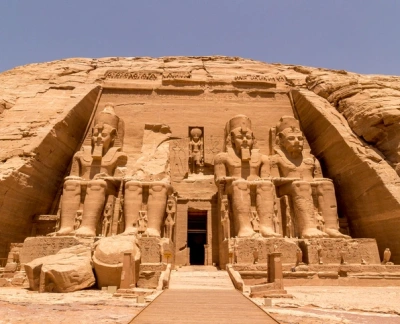
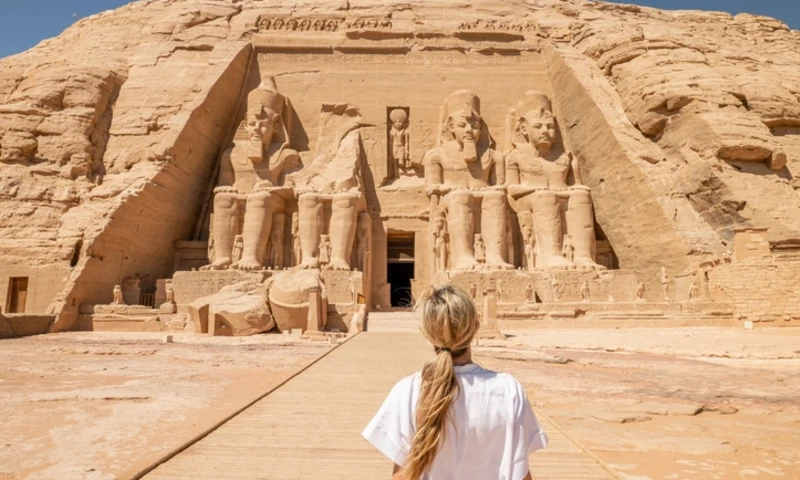
The Great Temple was carved out of the rock face during the Nineteenth Dynasty, when the site was under the control of the Egyptians, during the reign of Ramesses II, around 1264 BC (Egypt’s Ministry of Tourism and Antiquities). The façade of the temple is dominated by four enormous seated figures of the king. Unfortunately, one of the figures was severely damaged by an earthquake that occurred in antiquity and now remains as a huge mangled base with the remains of the seat and parts of the figure at the bottom of the remains of the legs.
The Monument of the Great Temple reflects a larger purpose than that of a mere architectural structure, as it further lists the royal and the divine representation of Ramesses II and the interior of the Temple connects the King to the principal deities worshipped in ancient Egypt.
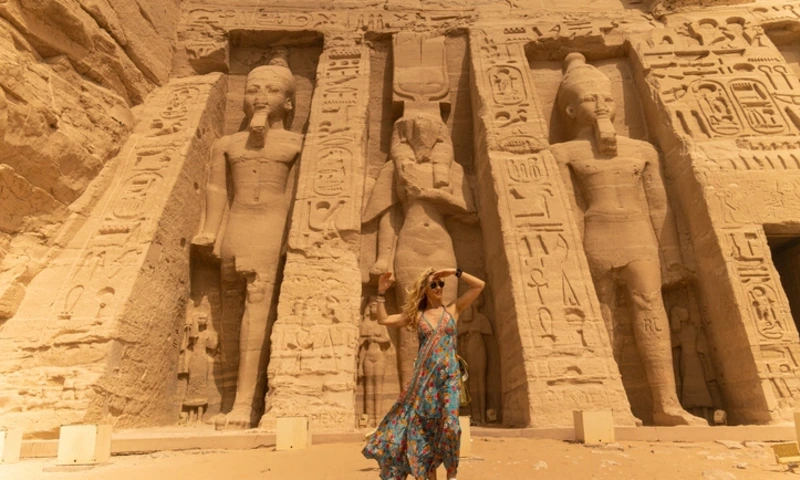
A second temple has been carved into the rock face of Abu Simbel, some distance from the Great Temple. It is called the Small Temple. It is dedicated to Hathor, with scenes of Queen Nefertari, Ramesses II’s Great Royal Wife. The way that the Queen is depicted in these scenes is unusual. Her colossal figures appear to be of the same scale to those of Ramesses II as he appears in other scenes throughout the Temple.
Together with the Small Temple these two monuments are part of the UNESCO World Heritage Sites the Nubian Monuments from Abu Simbel to Philae. These sites consist of archaeological remains and of rellocated temples in the Aswan region of Egypt.
What Can You See at the Ramses II Abu Simbel Temple?
The Ramses II Abu Simbel Temple is one of the two temples in Abu Simbel. The Ramses II Temple is the larger of the two, and while the facade of the temple gives some idea of the size of the interior, it is only when one actually enters the temple that the full extent of the interior of the structure is realized. The Temple is carved into the rock face and contains a number of interior halls and sacred spaces, in addition to the vast facade.
The Colossal Façade
This very impressive façade contains within it four massive seated figures of Ramesses II. For those who are to visit the temples prior to entering the actual buildings of the temples, he is an enormous figure!
Two of the four statues of Ramesses II are missing their heads and have sunk into the ground, while the third on the left of the center statue has fallen and is leaning against the side of the temple, its broken pieces visible near the facade.
Around the larger statues of the Pharaoh are depicted many smaller figures and reliefs, also with hieroglyphs. These have to be studied from up close. Only then can one fully appreciate the large stone façade as a work of art on two different levels.
Inside the Great Temple
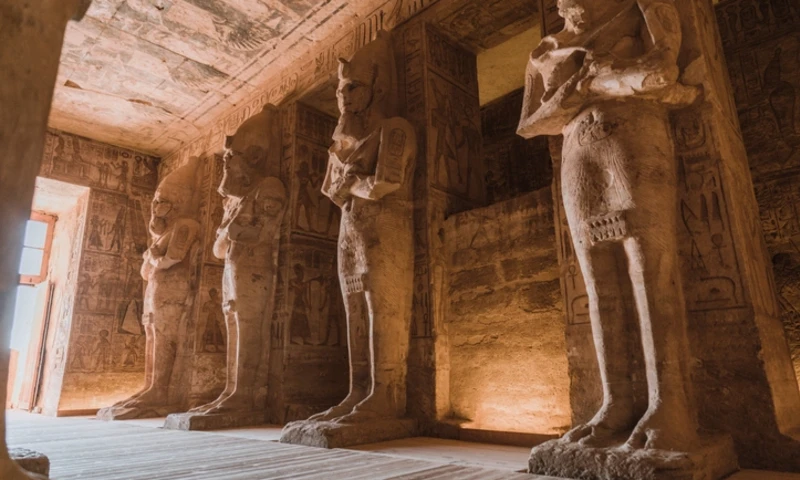
Large standing royal figures line the principal hall of the temple and direct visitors to the deeper parts of the Temple. The other halls and sacred spaces are also rich with decoration of Relief and hieroglyphic scenes, presenting religious imagery and royal narratives.
In the many halls leading to the heart of the Great Temple there are many standing royal figures pointing the way. The walls are covered in a myriad of reliefs and hieroglyphs which further relate the many stories of Ramesses II’s life and also carry many religious connotations and messages.
The statues in the temple’s sanctuary represent four gods, Amun-Ra, Ra-Horakhty, Ptah, and the deified Ramesses II.
The Sun Alignment
One of the most famous things about the Great Temple is that on two specific days of the year a beam of sunlight penetrates to the bottom of the Temple and illuminates the three statues of the Gods and the four statues of Kings in the endmost chamber of the Temple. Ptah is the only God to be excluded from the beam of sunlight. There are also two festivals held at Abu Simbel every year to celebrate these special occasions.
What Is the Nefertari Temple at Abu Simbel?
The Nefertari Temple at Abu Simbel, for the Queen Nefertari, built by Pharaoh Ramses II in deep love with his Queen, with a special standing for her, in a complex of other temples, for kings of Egypt. On the front of the temple, the facade, Ramesses II is shown standing with his wife, Nefertari. She is shown on an equal scale to her husband which is not usual and that is why this temple is often referred to separately from the Great Temple of Ramesses II. Inside, the reliefs illustrate the Temple of Hathor at Dendera, as well as the association of the Queen with Ramesses II in the Temple.
If one spends some time in both the Temples of the Great King and in the Temple of Nefertari, one would have a more complete vision of the great Monuments of the Abu Simbel complex. Of the two Abu Simbel temples, the larger Great Temple RAMSES II OF THE RAMSSES II complex focuses primarily on honoring and celebrating the monumental kingship of Pharaoh RAMSES II. The much smaller Temple NEFERTARI focuses primarily on honoring sacred queen and Lady of the House NEFERTARI, in addition to her relationship to her ultimate deity in life Hathor.
How Were the Abu Simbel Temples Relocated?
The modern history of Abu Simbel is almost as important as its ancient history. Construction of the Aswan High Dam threatened archaeological sites across Nubia with rising water, prompting Egypt and Sudan to request international assistance. UNESCO launched the International Campaign to Save the Monuments of Nubia in 1960.
The Abu Simbel relocation involved dismantling the temples into large numbered blocks and reassembling them at a higher site. UNESCO records that more than a thousand blocks, each weighing around 30 tons, were moved and reconstructed within an artificial cliff. The new position was approximately 64 meters above the former site and 180 meters inland.
The relocated temples were inaugurated at their new location in September 1968. The wider Nubian rescue campaign continued until 1980 and ultimately safeguarded numerous monuments threatened by the creation of Lake Nasser.
This operation became an important milestone in international heritage preservation. UNESCO links the Nubian campaign directly with the development of wider international cooperation for the protection of cultural heritage and the later World Heritage Convention.
For visitors, knowing this history changes the way the site is read. The mountain-like setting seen today was carefully reconstructed so the temples could preserve their relationship with their landscape while remaining above the rising waters.
How Do You Visit Abu Simbel from Aswan?
Abu Simbel lies in southern Egypt, within Aswan Governorate and close to the Sudanese border. UNESCO identifies the temples as being about 280 kilometers south of Aswan.
Travelers commonly plan the visit in connection with Aswan, which makes the city a practical base for reaching Abu Simbel and other Nubian sites. The exact transport arrangement depends on the trip selected, so departure details should be confirmed in advance.
What Should You Prioritize During the Visit?
- Study the four colossal figures on the Great Temple façade
- Enter the main hall and examine the royal statues and reliefs
- Continue toward the sanctuary
- Walk to the Small Temple of Nefertari
- Compare the scale and imagery of its façade with the Great Temple
- Look at the surrounding reconstructed landscape in the context of the relocation project
FAQs
1- What are the Abu Simbel Temples?
The Abu Simbel Temples are two rock-cut temples in southern Egypt associated with Ramesses II and Queen Nefertari. The larger temple honors the king and major deities, while the smaller temple is dedicated to Hathor and Nefertari.
2- What is special about the Ramses II Abu Simbel Temple?
The Ramses II Abu Simbel Temple is known for its four colossal seated statues, extensive interior reliefs, pillared hall, sanctuary, and solar alignment. It was cut into the rock during the Nineteenth Dynasty.
3- Why were the Abu Simbel temples moved?
The temples were threatened by rising water associated with the Aswan High Dam and the creation of Lake Nasser. An international UNESCO-led campaign dismantled and reconstructed them on higher ground.
4- Where are the Abu Simbel Temples located?
The temples are in Nubia in southern Egypt, near the country’s southern border and roughly 280 kilometers south of Aswan.
5- Is Nefertari represented at Abu Simbel?
Yes. The Small Temple is dedicated to Hathor and Queen Nefertari, and her colossal figures on its façade appear at the same scale as those of Ramesses II, an unusual form of royal representation.