

Introduction
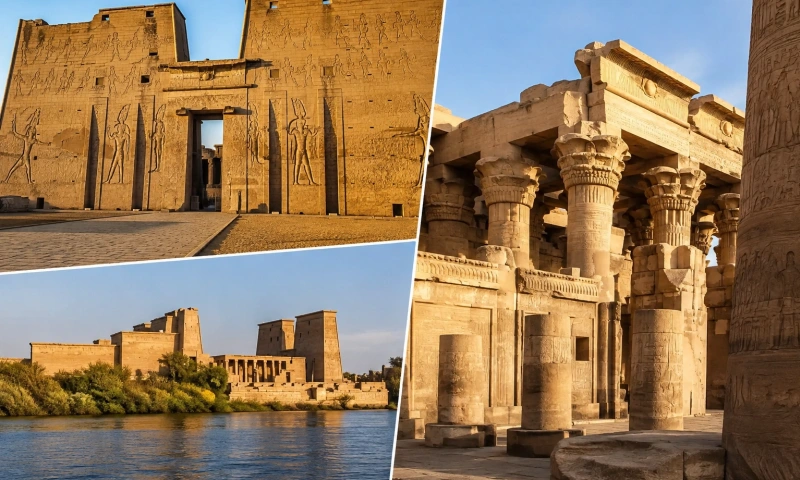
Two of Upper Egypt's most important temple stops stand between Luxor and Aswan, yet they tell very different stories. Edfu Temple Egypt is dedicated to Horus and preserves a monumental Ptolemaic temple plan, while Kom Ombo Temple is unusual for its symmetrical arrangement around two parallel sacred axes dedicated to Sobek and Harwer, or Horus the Elder.
Because both sites lie along the Nile corridor, travelers often encounter them within the same Upper Egypt journey. Visiting them together makes their differences particularly clear: Edfu emphasizes the cult of Horus through a large, highly ordered sanctuary, while Kom Ombo divides its religious space between two divine traditions.
For travelers following the river between Luxor and Aswan, the pair provides a useful bridge between the major temple complexes of Thebes and the monuments farther south around Aswan.
Table of content:
What Should You Know About Edfu Temple Egypt and Kom Ombo?
Both Edfu and Kom Ombo belong mostly to the Ptolemaic and Graeco-Roman eras, but in terms of architecture and religious purpose, they vary greatly.
Edfu features a temple built in honor of Horus on the west side of the river Nile. The construction work started in 237 BC during the reign of Ptolemy III and was finished in 57 BC during the time of Ptolemy XII. Hence, the construction process lasted about 180 years. One can attribute the preservation of the temple partly to the fact that it was buried underneath later debris and then excavated in the 19th century by Auguste Mariette, a French archaeologist.
Kom Ombo represents a different idea. While there was already a sanctuary built during the New Kingdom in Kom Ombo, the existing temple is from the Graeco-Roman period. The earliest royal name at Kom Ombo is Ptolemy VI Philometor. Most of its decorations have been finished in the times of Ptolemy XII.
One can connect their common localization in Upper Egypt, but one shouldn't think that either one is a smaller copy of another.
What Is the History of Edfu Temple Egypt?
History of Edfu Temple in Egypt is connected with the worship of Horus. The temple belongs to the last stage of development of monumental architecture of ancient Egypt and is the example of how Ptolemaic rulers maintained the ancient religious tradition of Egyptians, but at the same time appeared in the form of pharaohs.
Construction started in 237 BC in the time of Ptolemy III Euergetes I and lasted till the time of Ptolemy XII in 57 BC. Long construction period of the temple explains why the temple is rich with its architectural and decorative programs and not just separate sanctuary.
Survival of the monument is one of the reasons for its importance for study of temple architecture of ancient Egypt. The monument was partly covered by settlement material during many centuries, which saved from destruction many elements of architecture and decoration of the monument. The first restoration works in 1860 conducted by Auguste Mariette have uncovered a part of the monument.
In addition, recent restoration works have allowed to find out surviving traces of colors used for decoration of carved reliefs and inscriptions on stone surfaces of the monument.
Placing Edfu in the general route of travelers it can be linked with the Luxor Travel Guide and Aswan Travel Guide.
What Can You See Inside the Temple of Horus at Edfu?
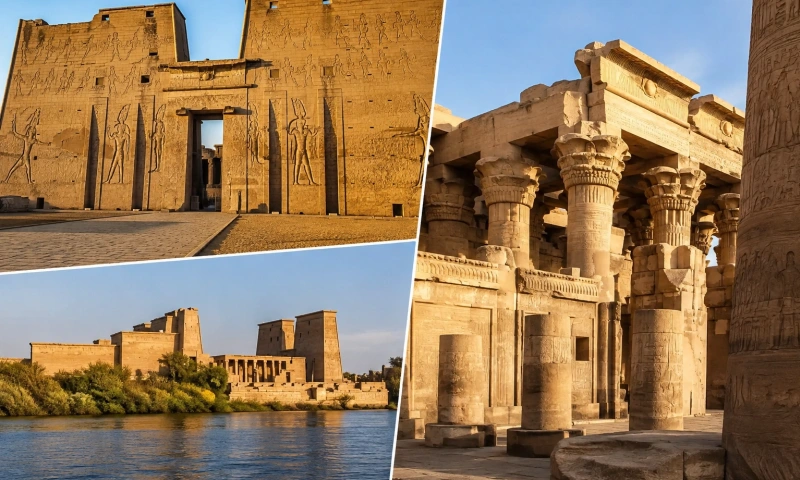
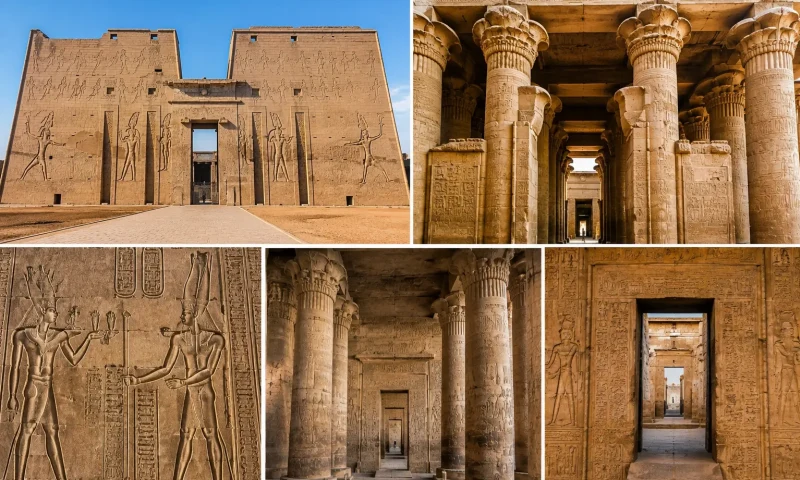
The temple scale is established as you approach the building because of two pylons that have relief images of Ptolemy XII fighting his enemies and offering gifts to various deities. Two granite figures of Horus in falcon form are located in front of the pylons.
After passing the gateway into the temple there is a peristyle court enclosed by columns with vegetal capitals. Then the layout continues to progress inwardly from more open to increasingly enclosed ritual spaces.
Hypostyle halls and ritual scenes
Further to the courtyard, there are two hypostyle halls. The first one retains the scenes related to the temple dedication and the king's contact with gods. The second one has images relating to the sacred bark of Horus and Hathor.
This helps understand the Edfu temple architecture. It does not contain several separate chambers but there is a gradual progression to ritual space through a series of halls.
Sanctuary and inner spaces
From the second hypostyle hall visitors go through a transverse hall to reach the sanctuary. This progression of scale and enclosure corresponds to the change in the religious meaning of every chamber.
Various inscriptions and architectural decorations of the temple retain information related to the ritual practices, kingship and the worship of Horus. Often the location of the scene is equally important as its interpretation.
Travelers who want to compare Edfu with temples of Upper Egypt should look at the guidebook for the Karnak Temple
What Makes Kom Ombo Temple Different?
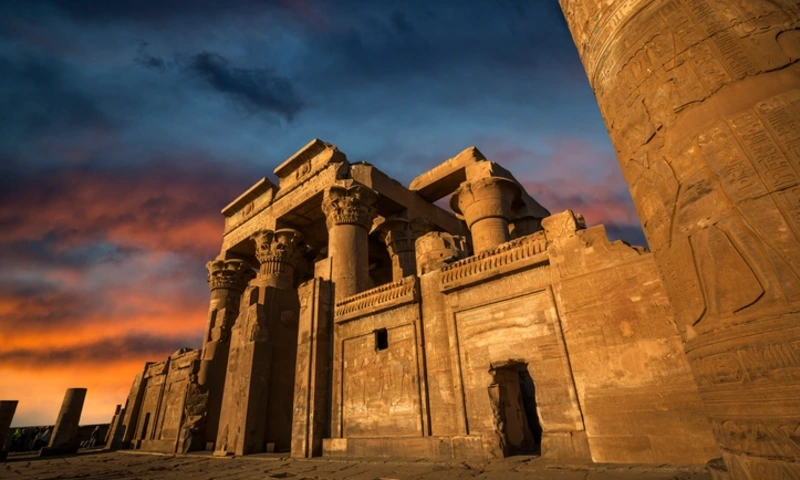
What makes the Kom Ombo Temple different is the fact that it is constructed around two parallel sacred spaces rather than one axis.
There were two main gods whose worship was performed in this temple: Sobek, the god of crocodiles who symbolized water and fertility, and Harwer/Horus the Elder. These two gods influenced the architecture of the temple. There were two parallel axes going through the colonnade halls and ending up at two sanctuaries, one of which was reserved for each of the gods.
While the southern axis was devoted to Sobek, the northern axis belonged to Harwer. At the same time both gods had their own divine family they were worshipped with. Thus, Sobek was worshiped along with Hathor and Khonsu while Harwer was accompanied by Tasenetnofret and Panebtawy.
That is the peculiarity which makes the architecture of the Kom Ombo temple plan unique.
Reliefs, calendars and medical images
The wall paintings are not only related to the worship of gods. The wall includes one calendar depicting festivals and ritual activity along with the Roman relief of the 2nd century which depicted objects believed to be surgical instruments.
The temple thus provides more than just information about architecture.
Why Is Kom Ombo Known as a Sobek Temple?
The association between Kom Ombo and crocodiles comes from the worship of Sobek. In ancient Egyptian religion, Sobek was connected with water, fertility, inundation and vegetation, making his cult particularly meaningful in a Nile-side setting.
The temple was not devoted exclusively to Sobek, however. Harwer received equal architectural importance, which is why describing Kom Ombo simply as a Sobek temple leaves out half of its religious design.
Crocodiles remain an important part of the visitor experience because the nearby Crocodile Museum displays mummified crocodiles found during archaeological excavations.
This connection helps explain why searches for Kom Ombo temple crocodiles are so closely associated with the site, but the broader context is the dual cult of Sobek and Horus the Elder rather than crocodile symbolism alone.
How Should You Plan a Visit to Edfu and Kom Ombo?
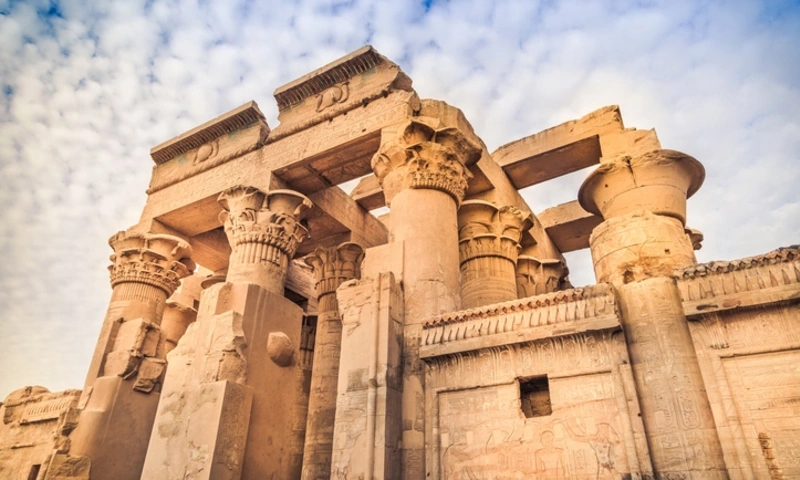
It is useful to approach Edfu and Kom Ombo as related but separate visits. Each deserves enough time to understand its architectural logic rather than simply photographing the façade and moving on.
At Edfu, follow the progression from pylons and courtyard through the hypostyle halls toward the sanctuary. At Kom Ombo, pay attention to the parallel arrangement of the two axes and how the decoration relates to Sobek and Harwer.
Current opening arrangements and ticket conditions can change, so verify practical information with official sources or your tour operator when planning your visit rather than relying on older travel pages.
If both sites form part of a cruise itinerary, review the scheduled stops in advance. Travelers joining organized journeys can compare Nile cruise packages or Egypt Travel Packages that connect Luxor, Edfu, Kom Ombo and Aswan.
FAQs
1- What is Edfu Temple Egypt known for?
Edfu Temple Egypt is dedicated to Horus and is one of the most complete surviving ancient Egyptian temple complexes. Its pylons, courts, hypostyle halls, sanctuary, reliefs and inscriptions preserve a clear Ptolemaic temple layout.
2- Who was worshipped at Kom Ombo Temple?
Kom Ombo Temple was dedicated to two gods: Sobek, represented as a crocodile or crocodile-headed deity, and Harwer, or Horus the Elder. The temple's two parallel axes and sanctuaries reflect this dual dedication.
3- Why are crocodiles associated with Kom Ombo?
Crocodiles were associated with Sobek, one of the temple's principal gods. Mummified crocodiles discovered through archaeological work are displayed in the nearby Crocodile Museum.
4- Can you visit Edfu and Kom Ombo on a Nile cruise?
Yes. Both temples are commonly associated with Nile routes between Luxor and Aswan, and many cruise itineraries include stops at one or both sites. Always check the individual cruise program before booking.
5- Are Edfu Temple and Kom Ombo Temple similar?
They share a broadly Ptolemaic and Graeco-Roman context, but their architecture and religious purpose differ. Edfu centers on Horus and follows a strong single-axis temple plan, while Kom Ombo divides its structure between parallel sanctuaries for Sobek and Harwer.